


Search

Search
Certifications
News & Events
3-A Knowledge Center
What if the safest ingredient in a dry powder food processing plant was a coating inside the equipment?
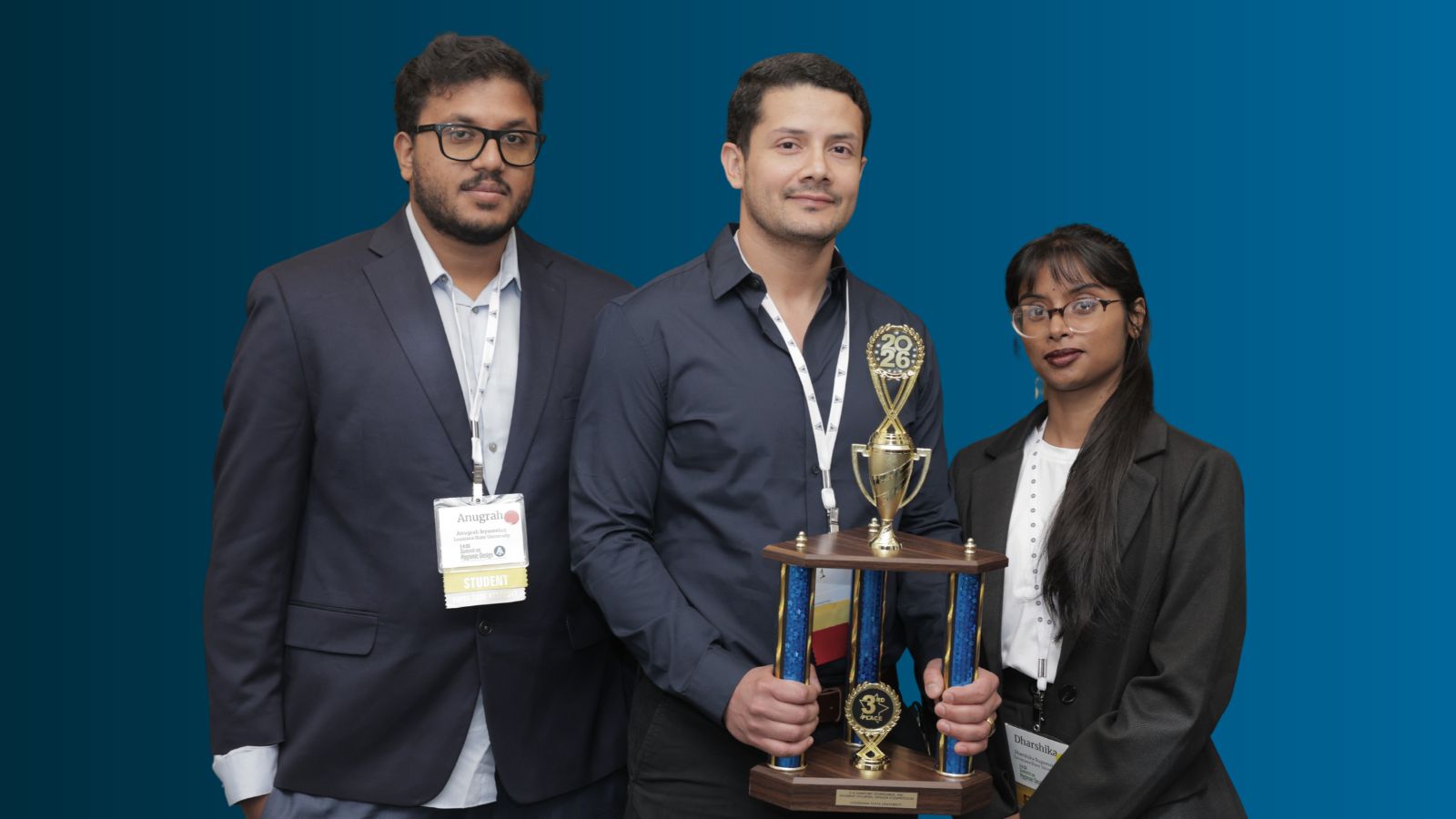
That's the thinking behind the third-place entry from a Louisiana State University (LSU) team in 3-A SSI's inaugural Student Hygienic Design Competition.
In the competition, student teams were asked to solve a real-world industry problem: residual dry powder clinging to the interior surfaces of food processing equipment.
In facilities handling products like dairy powders and infant formula, that buildup is more than a nuisance. It accumulates in pipe elbows, crevices, and dead spaces. Although wet cleaning can remove it, the introduction of moisture creates conditions where dangerous pathogens like Salmonella and Cronobacter can thrive.
Students’ solutions were required to conform to 3-A Sanitary Standards.
The LSU team's answer was to rethink the surface itself, developing a coating made from whey protein and starch – food-grade materials designed to be applied to equipment interiors.
Dharshika Sugumaran, a first-year master's student, Mario Melendez, a PhD student in the Food Engineering Lab, and Anugrah Jeyasellan, a graduate student in Food and Bioprocess Engineering, spent five months on the project – from idea generation to hypothesis testing, methodology development, and data collection. "Finally, we made it. We were so happy and excited," Dharshika said in an interview at the 3-A SSI 2026 Summit on Hygienic Design, where winning teams presented their solutions.
Each student team in the competition was paired with an industry coach — an experienced food processing or equipment design professional who provided technical guidance and helped teams navigate real-world constraints and 3-A Standards. For the LSU team, that coach was Allen Sayler, Managing Partner of the Center for Food Safety and Regulatory Solutions, and his guidance proved pivotal. "He got us in the right direction when we were having struggles in the beginning," recalled Anugrah. "We finally had a better idea of the coating that we were going to develop and the way it was going to be made."
The coating itself is straightforward in concept but carefully engineered in practice. A whey protein and corn starch solution is sprayed onto the interior surfaces of stainless steel equipment – think pipe elbows and hopper transitions, the spots where powder most likes to hang up – and dried with hot air to form a thin, uniform film. The result is a surface that powder simply doesn't stick to as readily, improving flow and reducing buildup without the need for structural changes to the equipment.
In lab testing, the difference was clear: the coated elbow discharged powder without clogging, while an uncoated control elbow showed noticeable clogging and residual buildup, even after compressed air cleaning.
The coating is designed to last approximately one week under dry-powder processing conditions. When it's time to clean, a standard alkaline rinse removes it completely – no visible residues, no surface irregularities. After cleaning, the coating can be reapplied as part of a scheduled maintenance cycle. No special equipment, no added complexity.
Because whey protein is a milk allergen, the coating is intended primarily for dairy-powder processing environments where milk is already a declared allergen, meaning it doesn't introduce a new allergen category.
The approach was developed in strict conformance with 3-A Sanitary Standards. "We were able to adhere to the 3-A SSI guidelines and successfully develop this coating, based on whey protein and starch, for the industry," explained Mario.
The concept clearly resonated with industry professionals at the Summit. "During our presentation, we were able to see that people were very interested in the industrial application of our coating," Mario noted. "Based on our results, we were able to answer their questions about the strength that our coating could have inside the pipelines and how it can be easily managed during daily activities."
For the LSU team, the competition was about more than a podium finish. Being invited to present at the Summit opened doors to the broader industry in ways that will shape the team members’ careers. The team also earned a $2,000 prize.
"It's a huge achievement and a great opportunity for us to come to 3-A SSI, network with others, talk to other companies, and get an understanding of the overall field," said Anugrah. "It provides us an invaluable experience that we will forever hold in our hearts."
Read more about the LSU team’s solution by downloading their competition submission.
Read our blog posts on other winning teams and their research:
• Kansas State University earned top honors with a two-pronged solution. By combining a static-dissipative coating for stainless steel surfaces with a controlled, heated air system, they addressed both electrostatic adhesion and powder flowability. Their approach was validated through rigorous experimental testing using soft wheat flour.
• Auburn University secured second place with an innovative air plasma-assisted dry sanitation system. This solution integrates engineered turbulent airflow with plasma-generated reactive oxygen and nitrogen species (RONS) to achieve mechanical powder detachment and microbial inactivation without the use of water.
At 3-A SSI, this year's World Standards Day arrives at an especially appropriate moment. Across the organization's standards-development program, technical experts representing equipment fabricators, processors and users, regulators and other stakeholders are actively participating in the development and maintenance of hygienic equipment standards.

Observers are sought for 10 active 3-A SSI Working Groups
A proposed revision brings 57-02 in line with the updated General Requirements. You have until Nov. 16 to weigh in.

A team of poultry science students from Auburn University earned second-place honors in the 2026 Student Hygienic Design Competition with a novel solution based in physics.


