


Search

Search
Certifications
News & Events
3-A Knowledge Center

Three poultry scientists walk into a dairy competition.
They finish in second place.
That's the short version of Auburn University's entry in 3-A SSI's inaugural Student Hygienic Design Competition. In the competition, student teams were challenged to solve a real-world industry problem: residual dry powder clinging to interior surfaces of food processing equipment.
In facilities handling products like dairy powders and infant formulas, that buildup is a serious food safety concern. It accumulates in pipe elbows, crevices, and dead spaces, and while wet cleaning can remove it, the introduction of moisture creates conditions where dangerous pathogens like Salmonella and Cronobacter can thrive.
Students’ solutions were required to conform to 3-A Sanitary Standards.
The Auburn team's answer came not from dairy science, but from physics.
Three PhD students – Telah Black, Sofia Sierra, and Vianca Tashiguano – came to the competition from an unexpected angle — their primary research focus is poultry, not dairy. It’s more evidence that 3-Sanitary Standards are transferable from dairy to any number of food and pharmaceutical applications.
"We are not very familiar with the dairy industry because that's not our primary field of work," Telah acknowledged in an interview at the 3-A SSI 2026 Summit on Hygienic Design. "We work with poultry." But the team's deep expertise in cold plasma, food contact surfaces, and microbiology made them well-suited to the challenge. Telah works in spectral imaging to detect contamination sites invisible to the human eye, as well as in microbiology and AI. Sofia works with cold plasma on food contact surfaces, with a focus on Cronobacter sakazakii and Salmonella. Vianca develops digital twin models to track pathogen movement through processing plants.
Cold plasma is sometimes called the fourth state of matter. When air is energized by an electric field, it becomes partially ionized, generating reactive oxygen and nitrogen species (RONS), including hydroxyl radicals and superoxide anions. These reactive species are highly effective at breaking down bacterial DNA, proteins, and lipids, leading to microbial inactivation. And crucially, after doing their work, they revert to stable forms, leaving no chemical residues behind.
The Auburn team proposed integrating this technology directly into dry powder processing pipelines. Plasma-activated air is pumped through the system at turbulent velocities, generating wall shear stress that mechanically dislodges powder residue from elbows, crevices, gasket interfaces, and other hard-to-reach areas while the RONS simultaneously inactivate pathogens. The system operates entirely without water or liquid chemicals, keeping it fully compatible with dry processing environments.
The units would be installed inline at critical control points, such as dryer discharge, fluid bed outlets, and pre-packaging sections, and would operate during scheduled cleaning cycles between production runs, not during active production. The number of units installed can be scaled to the facility's size and risk profile.
For a team whose expertise lies in poultry science, placing second in a competition focused on dairy powder processing was a meaningful validation.
"For us to be placed in second place is actually just an honor," said Telah. "I cannot thank 3-A SSI enough, and the judges, for allowing us to be one of those placeholders in the top three."
The Auburn team earned a $3,000 prize and presented its work at the Summit, giving them a window into an industry outside their usual world and a chance to see how broadly applicable their work could be.
Read more about the Auburn team’s solution: Download the research.
Read our blog posts on other winning teams and their research:
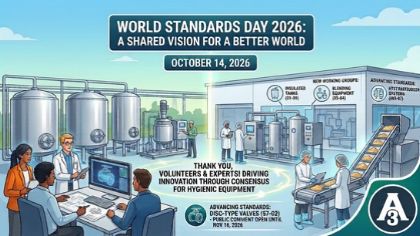
At 3-A SSI, this year's World Standards Day arrives at an especially appropriate moment. Across the organization's standards-development program, technical experts representing equipment fabricators, processors and users, regulators and other stakeholders are actively participating in the development and maintenance of hygienic equipment standards.

Observers are sought for 10 active 3-A SSI Working Groups
A proposed revision brings 57-02 in line with the updated General Requirements. You have until Nov. 16 to weigh in.
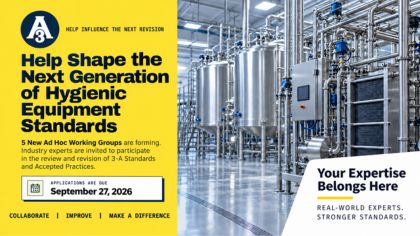
3-A SSI invites volunteers for five new Ad Hoc Working Groups to revise four 3-A Sanitary Standards and one Accepted Practice.


