


Search

Search
Certifications
News & Events
3-A Knowledge Center

Trade shows are often measured in numbers. Booth visitors. Badge scans. Business cards exchanged. Miles walked across the convention center.
But when I think back on PACK EXPO 2026, I remember the conversations.
Over several days, I talked with equipment manufacturers, processors, engineers, consultants and longtime 3-A SSI supporters. Some arrived with specific questions. Others knew the 3-A name and wanted to learn how to get involved.
I helped staff our booth, co-presented an Industry Speaks session with Meri Beth Wojtaszek, executive director of 3-A SSI, and met with current and prospective stakeholders. Each activity served a different purpose, yet all of them pointed to the same conclusion: People want trusted resources, practical guidance and meaningful ways to help advance hygienic equipment design.
Our booth drew everyone from longtime Symbol Holders to people meeting 3-A SSI for the first time. Two topics led the way: our Third Party Verification (TPV) program and our enhanced 3-A Certificate Directory.
Many visitors wanted to understand how TPV works and why independent verification matters. Manufacturers asked about earning authorization to display the 3-A Symbol. Processors, regulators and end users wanted a reliable way to identify equipment that has undergone an independent review.
These conversations were rarely about compliance alone. Most were about confidence. People want assurance that hygienic design claims rest on a credible, transparent process, and TPV remains one of the strongest ways 3-A brings consistency and trust to the industry.
The upgraded directory struck a similar chord. Visitors liked how easily they can now find current Symbol Holders and participating manufacturers. Some plan to use it for sourcing and supplier qualification. Others simply valued having the information in one place.
Interest in both programs reflects a broader shift. Industry professionals expect information that is easy to find, easy to verify and backed by a credible organization. Those expectations sit squarely within the mission of 3-A SSI.
We also discussed Working Groups, eLearning, the Certified Conformance Evaluator (CCE) program and student engagement. What encouraged me most was how many people wanted to help shape our standards, not just use them. Several asked how to join our Ad Hoc Working Groups. The answer? All 10 of the active Working Groups welcome observers now. Also, the Working Group on Disc-Type Valves (57-02) has produced a proposed update that is open for public comment through Nov. 16, 2026.
The Industry Speaks session Meri Beth and I presented focused on hygienic design in today's food and beverage manufacturing. We explored how design principles, standards development and independent verification support food safety and operational performance, and how thoughtful equipment design improves cleanability, reduces contamination risk and makes operations more efficient.
The audience was both engaged and diverse. Some attendees design or build equipment. Others oversee quality systems, food safety programs, maintenance or plant operations. Each saw hygienic design through a different lens, yet their questions echoed something I've heard at industry events for several years: People want actionable information. They want to know what good hygienic design looks like and how to apply it in their own plants, under real business constraints.
That appetite plays to one of our core responsibilities. Through presentations, online learning, standards development, the 3-A SSI Summit and industry collaboration, we work to close the gap between principles and practice.
Some of my most valuable conversations happened away from the booth. Walking the floor, I visited equipment manufacturers, Symbol Holders and industry partners. We talked about Ad Hoc Working Group activity, standards development, training, verification and how hygienic design is evolving across the industry.
More than once, someone opened by saying they had recently heard about 3-A SSI and wanted to learn more. That tells me our outreach is working. It also shows that interest in hygienic design now reaches well beyond the audiences traditionally associated with 3-A standards.
What I will remember most is the enthusiasm. I met professionals eager to deepen their understanding of hygienic design, manufacturers seeking to strengthen confidence in their equipment and experts ready to volunteer through our working groups. I also reconnected with longtime contributors whose efforts keep 3-A SSI relevant.
More organizations now see hygienic design as essential to food safety, operational excellence and brand protection, not simply a compliance issue. Meeting the evolving challenges in food, beverage and pharmaceutical manufacturing will take manufacturers, processors, regulatory representatives, sanitarians, educators and technical experts working together. That collaborative spirit has always been at the heart of 3-A SSI, and PACK EXPO showed me it remains strong.
The questions we fielded and the relationships we strengthened will shape how we support Symbol Holders and the broader hygienic design community in the months ahead. That is why we keep coming back to PACK EXPO: to listen, learn, educate and connect. I look forward to welcoming new participants into the 3-A SSI community.
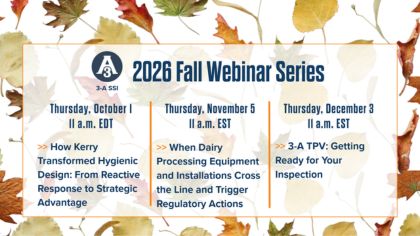
Register now for the final two sessions in the 3-A SSI 2026 Fall Webinar Series. (You'll get a link to see the first session too!)
Five groups are kicking off, five are deep in technical review andone proposed update is already open for comment.

At the EHEDG World Congress in Vienna, Austria, 3-A SSI Executive Director Meri Beth Wojtaszek saw how putting working groups and their volunteers front and center can energize a field. Here's what she brought home and how 3-A SSI plans to spotlight its updated standards at the 3-A SSI 2027 Summit on Hygienic Design.

A team from Louisiana State University earned third-place honors in the 2026 Student Hygienic Design Competition. Learn how they approached the challenge and what the competition meant to them.


