


Search

Search
Certifications
News & Events
3-A Knowledge Center

Powder sticks. That's a problem. And in food processing facilities handling dairy powders or infant formula, it's not just a nuisance: It's a food safety crisis waiting to happen.
Dry cleaning solutions are a critical industry need. When residual powder clings to pipe elbows, crevices, and dead spaces inside processing equipment, wet cleaning can remove these residues, but it introduces moisture that allows pathogens like Salmonella and Cronobacter to proliferate. It's a persistent and genuinely difficult challenge. That’s why 3-A chose it for the inaugural Student Hygienic Design Competition. Teams’ solutions were also required to conform to 3-A Sanitary Standards.
A trio of PhD researchers from the Kansas State University ( KSU) Department of Grain Science and Industry didn't just rise to that challenge. They won it.
Shivaprasad Doddabematti Prakash, Suhan Bheemaiah Balyatanda, and Jared Rivera came to the competition with a natural advantage: all three work with low-moisture foods in their research. "This was a very challenging and very exciting opportunity for us to use our expertise in the field," said Shivaprasad in an interview at the 3-A SSI Summit on Hygienic Design.
The KSU team’s goal from the start was to develop something innovative that could actually work at industrial scale, not just in a lab. As Suhan explained, they kept returning to the core questions of hygienic design: Is this safe? Can it be cleaned effectively? Is it compatible with food?
The Kansas State team attacked the problem two ways, proactively and reactively.
To prevent powder from sticking in the first place, the team developed a static-dissipative coating for stainless steel surfaces.
Electrostatic charge is a key reason dry powders cling to equipment surfaces, so neutralizing that attraction stops the problem at its source. The coating is applied electrostatically as a dry powder and thermally cured, forming a smooth, continuous, non-porous film that resists scratching, doesn't soften or scuff under continuous powder contact, and maintains its surface integrity over long production runs. It can be applied to fabricated parts before assembly, making it viable for both new equipment builds and retrofits.
The reactive part of the team's solution used a forced-air system running at elevated temperatures and low humidity. It improved the flowability of powders during processing and cleaning, so residue that does accumulate can be released and removed without water.
The team validated the approach using soft wheat flour, chosen deliberately as a worst-case scenario due to its high cohesiveness.Testing showed that exposure to heated, low-humidity air reduced the flour's cohesion and wall friction against stainless steel, meaning residue would be significantly easier to dislodge during cleaning.
"We made a stainless steel coating that can be applied to most of the general equipment surfaces to prevent powder sticking," Jared explained. "The second solution just focuses on improving the flowability of the powders during processing… by using heated air, we expect that it can be easily released from the powder equipment, improving the processing and cleaning processes for the industry."
The KSU team earned a $5,000 prize and presented its work at the Summit. It was an experience Jared described as far more than just an award ceremony.
"It's a great honor, because not only did we have a chance to get invited here, we also had the chance to learn more about the industry," Jared continued. "Talking with leaders, learning about different sanitation standards that can be useful in our future research… and one of our goals as researchers is to provide solutions that can be practically applied in the industry. Being recognized for that is just a great honor."
The competition was conceived not just to solve a technical problem, but to address something the food and beverage industry faces more broadly: a shortage of early-career professionals who understand hygienic design from day one.
"The food and beverage industry suffers from two critical challenges: the need for improved hygienic design solutions and a shortage of early-career professionals who understand hygienic design from day one," said 3-A SSI Executive Director Meri Beth Wojtaszek. "This competition was conceived as a way to address both of these challenges and to give the world's most talented students a shot at solving a real-world food safety challenge."
If the inaugural competition is any indication, that talen tis already here.
Read more about the KSU team’s solution: Download the competition submission.
Follow our blog to read about the two other winning teams' entries in future posts:
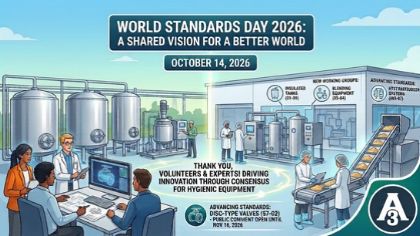
At 3-A SSI, this year's World Standards Day arrives at an especially appropriate moment. Across the organization's standards-development program, technical experts representing equipment fabricators, processors and users, regulators and other stakeholders are actively participating in the development and maintenance of hygienic equipment standards.

Observers are sought for 10 active 3-A SSI Working Groups
A proposed revision brings 57-02 in line with the updated General Requirements. You have until Nov. 16 to weigh in.

A team of poultry science students from Auburn University earned second-place honors in the 2026 Student Hygienic Design Competition with a novel solution based in physics.


