


Search

Search
Certifications
News & Events
3-A Knowledge Center
Here's a scenario that plays out in dairy plants more often than anyone would like to admit.
Two bids come in for a piece of processing equipment. One runs $40,000 less than the other. Finance likes the number. Procurement signs off. The lower bid wins.
Three years later:
The savings is blown, and then some.
If you've been in this industry any length of time, you've probably seen this movie. Maybe you've lived it.
The problem isn't that someone made a bad decision. The problem is that the decision got made without all of the information. Acquisition price got scrutinized. Everything downstream, operating costs, maintenance, downtime, compliance, got estimated loosely or skipped altogether.
That gap matters because those downstream costs typically account for 70 to 80 percent of what a piece of equipment costs over its working life. That's not a rounding error. That's the whole ball game.
...Downstream costs typically account for 70 to 80 percent of what a piece of equipment costs over its working life. That's not a rounding error. That's the whole ball game.
Think about what actually accumulates over a decade and a half of equipment service:
None of this shows up on the original quote. But all of it tracks back to design choices made long before the equipment left the factory floor.
That's the reason hygienic design standards exist in the first place. 3-A Sanitary Standards spell out how equipment should drain, how surfaces should be finished, what materials belong in contact with product, and how easily a technician can inspect and clean the equipment.
Equipment carrying the 3-A Symbol has been checked against those standards by an independent third party. You don’t have to just take the manufacturer's word for it. That verification isn't decoration. It shows up in what it costs to operate the equipment.
Every cleaning cycle costs something: water, chemicals,energy, steam, and the production time it eats. Equipment built to 3-A Standards clears CIP faster and uses fewer resources to do it, because the standard requires proper drainage, eliminates dead legs, and calls for surfaces smooth enough to rinse clean the first time.
Run that math across your weekly cycle count: 50 weeks ayear, over 15 years of service, and a small efficiency gap. It turns into a real number.
3-A Standards set minimums for stainless steel grade, elastomer compatibility, and surface finish, the specs that determine whether a part shrugs off years of heat and chemical exposure or starts pitting and failing early. Equipment built to 3-A Standards holds up longer.
Access matters too. When a component is easy to reach, techs actually service it on schedule instead of putting it off. Maintenance done on time almost always costs less than a repair done in a hurry.
What is your facility's real cost of an hour of unplanned downtime? Include lost output, spoiled product, overtime, a rush service call. How many of those unplanned downtime hours can you tolerate over 15 years?
Cleaning failures and contamination events are among the most common causes of an unplanned line stoppage, and equipment that wasn't built for reliable cleaning is often the reason for them. Equipment with the 3-A Symbol has already been checked against the design Standards, including quick-disconnect fittings, verified drainage, and construction suited to CIP. It’s all about heading those cleaning failures off.
Commissioning a line and keeping it compliant with the Pasteurized Milk Ordinance, FSMA preventive controls and state inspections takes documentation, and documentation takes engineering hours. Equipment carrying the 3-A Symbol comes with independent proof that it meets recognized sanitary design criteria, which shortens that work considerably. Buy equipment without it, and your team builds that same documentation from a blank page, on your budget and your time.
Two questions belong in every vendor conversation, before price even comes up:
A vendor selling equipment built to hold up in a dairy plant will answer both without hesitation.
Before your next equipment purchase, put a dollar figure next to each of these four categories for every option on the table. You don't need to be precise. A reasonable estimate will reveal the gaps. Bring in the maintenance manager, the QA lead and a finance stakeholder. Each one will spot costs the others miss.
Set your baseline before you compare anything else: 3-A Symbol authorization. More than 650 manufacturers currently hold 3-A Symbol authorizations across pumps, valves, heat exchangers, tanks, sensors, CIP systems and more. That's not a narrow field. It's a floor that protects the investment.
The equipment that wins the bid isn't always the equipment that wins the decade. A Total Cost of Ownership analysis is what closes the gap, and it's easier to run than most people assume.
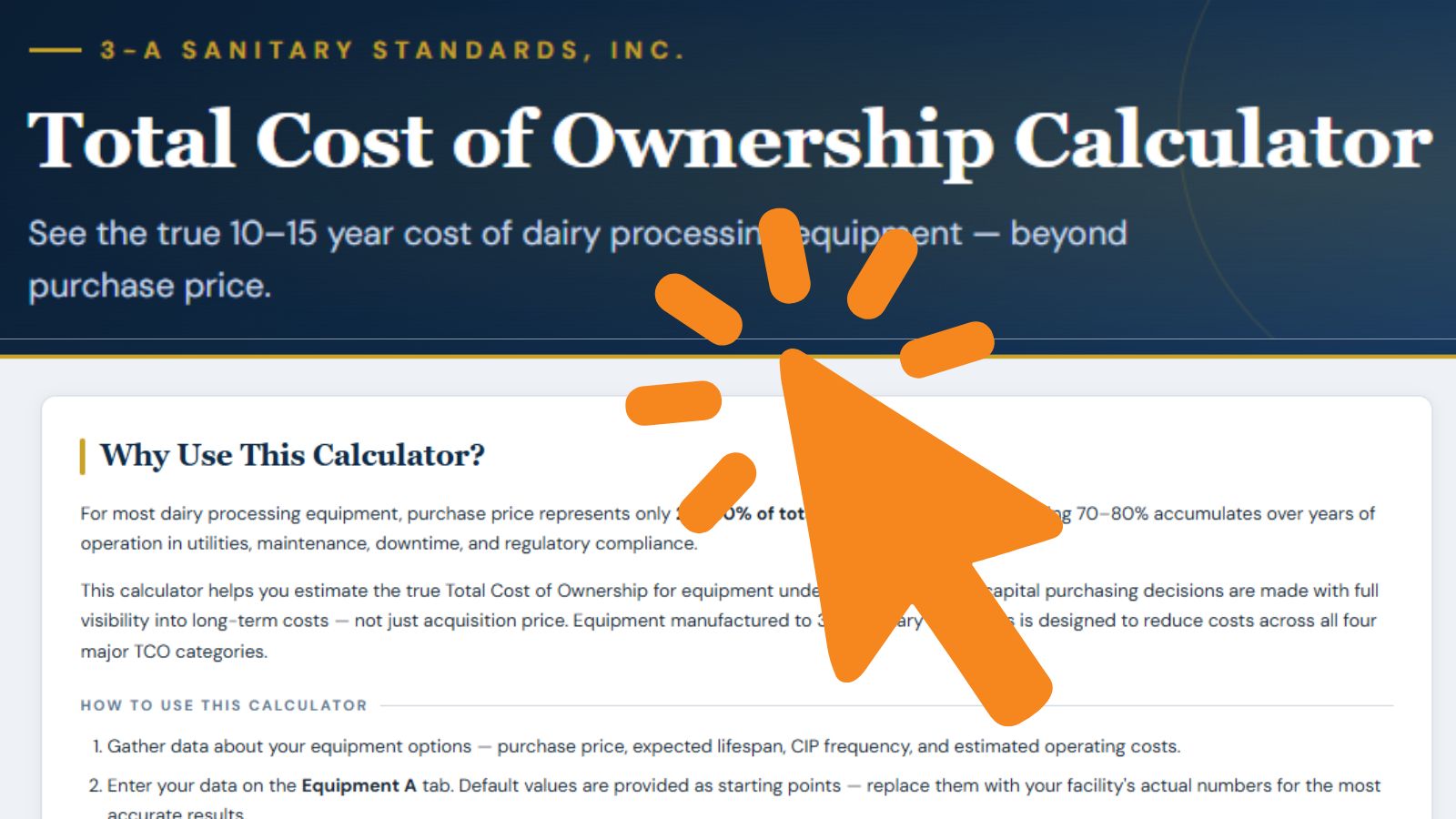
We built a free Total Cost of Ownership calculator to support your evaluation. Plug in your CIP volumes, maintenance costs and downtime exposure to get a full lifecycle comparison in about 10 minutes. You can even access the 3-ASSI Certified Equipment Directory right from the calculato rto see your options.
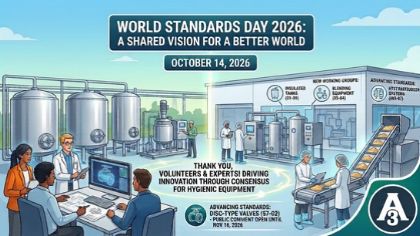
At 3-A SSI, this year's World Standards Day arrives at an especially appropriate moment. Across the organization's standards-development program, technical experts representing equipment fabricators, processors and users, regulators and other stakeholders are actively participating in the development and maintenance of hygienic equipment standards.

Observers are sought for 10 active 3-A SSI Working Groups
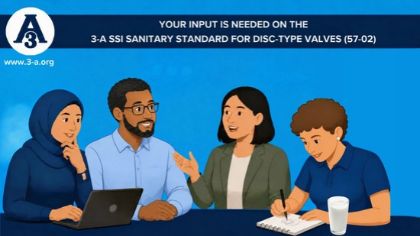
A proposed revision brings 57-02 in line with the updated General Requirements. You have until Nov. 16 to weigh in.

A team of poultry science students from Auburn University earned second-place honors in the 2026 Student Hygienic Design Competition with a novel solution based in physics.


