


Search

Search
Certifications
News & Events
3-A Knowledge Center
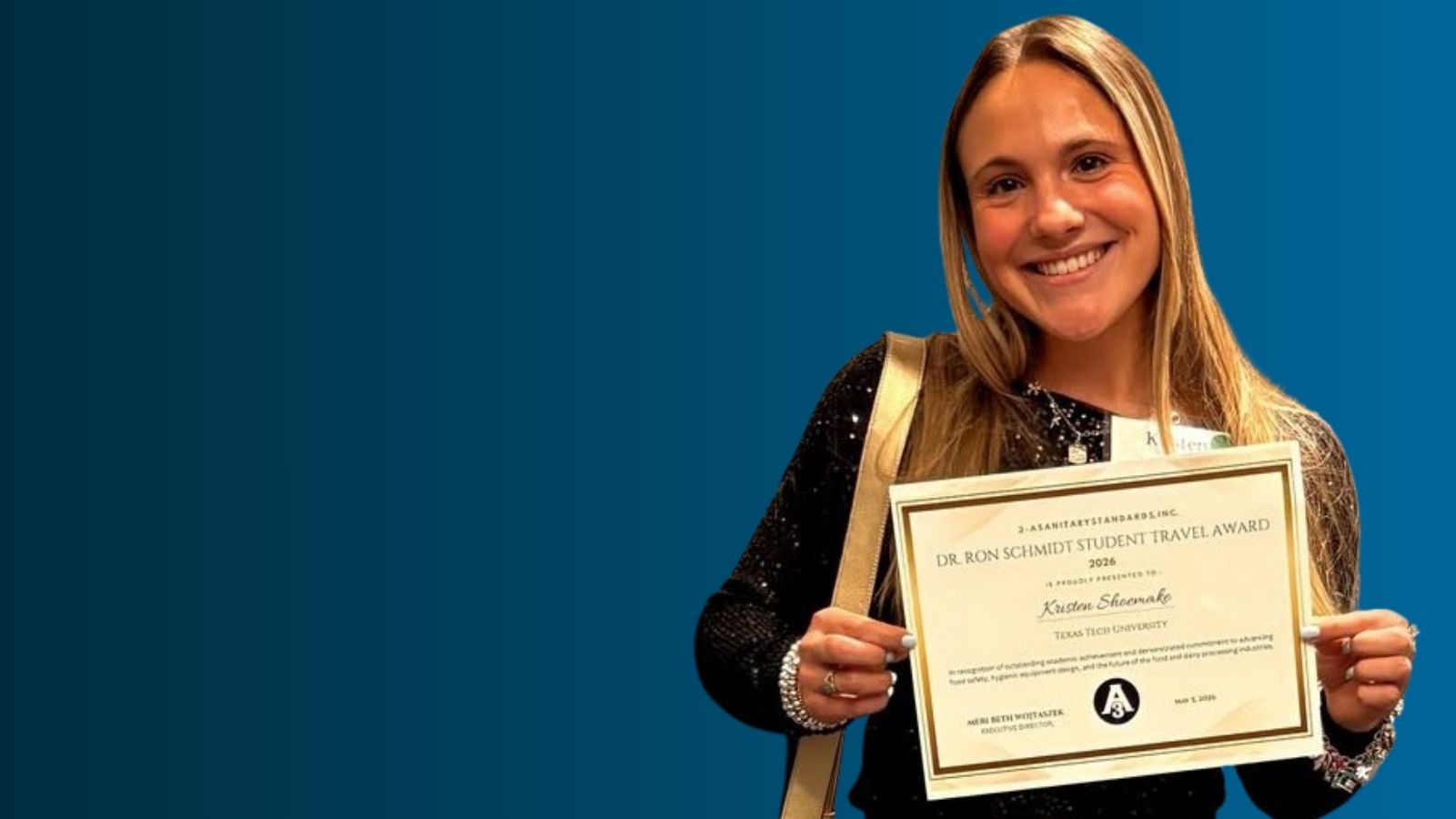
Kristen Shoemake is one of 11 students selected to receive a 3-A SSI 2026 Dr. Ron Schmidt Student Travel Award. A Ph.D. student at Texas Tech University, Shoemake focuses her research on food microbiology and meat safety.
The recognition, Shoemake said, honors both her dedication to food safety research and her goal of becoming a leader in the food industry. Attending the 3-A SSI Summit gave her the chance to engage with industry experts and gain perspectives beyond the laboratory. She plans to build on the experience by strengthening relationships with professionals across equipment design, sanitation and regulatory sectors, and by folding what she learned into her research. The Summit reinforced her goal of pursuing a career in research and development, where she can develop science-based solutions that improve food safety while meeting industry needs.
Among her biggest takeaways: hygienic equipment design is the foundation of effective food safety programs. Sanitation procedures and antimicrobial interventions matter, Shoemake said, but they cannot fully compensate for equipment that is difficult to clean or that harbors microorganisms in inaccessible areas. She also noted how collaborative the 3-Acommunity is, with manufacturers, processors, researchers and regulatory professionals working toward a shared goal of improving food safety through science, innovation and standardization. That collaboration, she said,underscored how much interdisciplinary work matters in solving complex food safety challenges.
She was encouraged to see people from diverse backgrounds working together to improve equipment, sanitation practices and standards that protect public health, and their willingness to mentor the next generation of scientists motivated her to keep pursuing research with real-world applications.
What inspired Shoemake most was meeting professionals who have built their careers around continuous innovation in food safety. She was encouraged to see people from diverse backgrounds working together to improve equipment, sanitation practices and standards that protect public health, and their willingness to mentor the next generation of scientists motivated her to keep pursuing research with real-world applications. The experience affirmed her belief that the most impactful research happens when academia and industry work together.
A summary of Shoemake's research on food microbiology and meat safety follows below.
Effective microbiological sampling is essential for verifying process control during carcass cooling in beef processing facilities. This study evaluated the efficacy of two commonly used sampling tools—traditional sponges and pre-moistened MicroMitts—for their ability to recover microbial indicators from beef fore-shanks in the hot boxduring the critical early cooling phase.
A total of 27 carcass samples (300 cm² each) were collected from fore-shank locations in the hotbox using both sampling methods. Samples were composited in sets of three using a dry pooling approach and analyzed for aerobic counts (AC), Enterobacteriaceae (EB),and generic Escherichia coli (EC) using the TEMPO® system. Paired t-tests were conducted to compare microbial recovery between methods, with significance determined at P < 0.05.
Results demonstrated that MicroMitts consistently recovered higher microbial loads than sponges across multiple sampling locations and processing stages. Statistically significant differences (P < 0.05) were observed for aerobic counts and Enterobacteriaceae in several comparisons, while E. coli recovery followed similar trends. These findings indicate that MicroMitts provide a more sensitive method for detecting microbial presence on carcass surfaces.
Enhanced recovery of indicator organisms improves the ability of processors to accurately evaluate sanitation effectiveness and identify contamination hotspots. By minimizing the risk of underestimating microbial loads, the use of more effective sampling tools can strengthen food safety systems, support regulatory compliance, and enable more proactive risk management strategies.
These findings underscore the importance of selecting appropriate sampling methodologies to ensure accurate microbial monitoring and reinforce process control within beef processing operations.
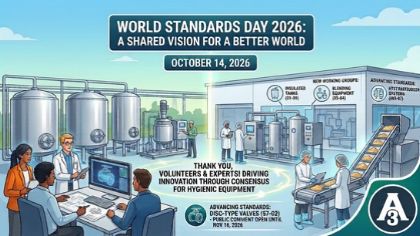
At 3-A SSI, this year's World Standards Day arrives at an especially appropriate moment. Across the organization's standards-development program, technical experts representing equipment fabricators, processors and users, regulators and other stakeholders are actively participating in the development and maintenance of hygienic equipment standards.

Observers are sought for 10 active 3-A SSI Working Groups
A proposed revision brings 57-02 in line with the updated General Requirements. You have until Nov. 16 to weigh in.

A team of poultry science students from Auburn University earned second-place honors in the 2026 Student Hygienic Design Competition with a novel solution based in physics.


