


Search

Search
Certifications
News & Events
3-A Knowledge Center

This year's IAFP Annual Meeting in New Orleans covered a lot of ground for anyone working in hygienic design and restoration. Hygienic design, restoration and lifecycle thinking were not side conversations; they were front and center.
I met with food manufacturer representatives, regulatory professionals, fabricators and service providers throughout the week. Across three sessions, including a five-minute overview I delivered for the IAFP Food Hygiene & Sanitation Professional Development Group (PDG) and two hygienic design roundtables, it became clear the industry is starting to treat hygienic integrity as a strategic priority rather than a technical detail.
Below is a recap of the week: the sessions, the conversations and the people who shaped them.
I opened the PDG session with a five-minute overview of 3-A SSI. The room was full, with people lining the walls, and it gave me a chance to speak directly to fabricators, inspectors, engineers, sanitarians and quality managers who deal with hygienic design decisions every day.
I covered the 1920s origins of 3-A sanitary design, the universal criteria that still define hygienic equipment (cleanability, inspectability, drainability,surface finish and material compatibility), and the strength of our model: consensus-based, standards-backed by independent third-party verification. I also pointed to the scale of that work: more than 650 manufacturers, nearly 100 equipment standards, and hundreds of TPV inspection reports each year.
I introduced our newest resource, the Total Cost of Ownership Calculator, which I expanded on in two later sessions.The message landed: purchase price is only 20% to 30% of equipment cost, and downstream costs account for the other 70% to 80% over the equipment's life.
Sponsored by the Food Hygiene & Sanitation PDG, this roundtable brought together experts focused on the realities of restoring hygienic integrity in legacy facilities.
Panelists included Adwy van den Berg, Director at EHEDG; Scott King, Vice President of Food Safety at Fortrex; James Davis, Senior Director of Global Sanitation at OSI Group; Nathan Mirdamadi, Global Director of Sanitation at Kerry; and myself. Josie Greve-Peterson, Corporate Microbiologist at Fortrex, moderated.
The session opened with a question from the moderator that shaped the entire discussion: Was the facility ever truly hygienic in the first place, or did we simply assume it was?
We covered the distinction between hygienic restoration, sanitation improvement, CAPA and RCA. We talked through how to diagnose design-related failures when environmental data is incomplete, and how to make restoration decisions when the "smoking gun" is never found. We discussed how evolving regulations, including PFAS rules, USDA Listeria species testing and the European Union's zero-tolerance policy, are accelerating the need for restoration. We also covered how to manage construction in an active food facility without introducing new contamination risks, and how to keep a restored facility from sliding back into legacy conditions.
My contributions centered on the 3-A perspective: restoration is triggered when equipment cannot be cleaned, sanitized, inspected or maintained according to hygienic design criteria. When design fails, sanitation cannot compensate.
Hygienic restoration is not a crisis response. It is a strategic commitment that protects product integrity, brand reputation, regulatory compliance and operational continuity. It also forces the hard questions: What does "good enough" mean? When does it stop being enough? How do we justify investment before failure?
Sponsoredby three PDGs, Sanitary Equipment & Facility Design, Food Hygiene & Sanitation and Retail & Food Service, this panel brought perspectives from processing, retail, academia, regulatory and global hygienic design leadership.
Panelists included Hein Timmerman, Diversey/Solenis and President of EHEDG; Howard Popoola, Kroger Company; Mark Moorman, FDA (retired); Haley Oliver, Ph.D., Purdue University; Angela Valadez, Publix; and myself.
We discussed how hygienic design has improved food safety in processing, and what lessons apply to retail and food service. We talked about why equipment selection and procurement matter as much as sanitation, and how tight spaces, aesthetics and consumer-facing environments complicate design. We also covered how to teach the next generation of food safety professionals about hygienic design, and how to engage equipment manufacturers through standards and third-party verification.
...The procurement blind spot is universal. Whether you're buying a pump for a processing plant or a slicer for a retail deli, the same truth applies: equipment that wins the bid doesn't always win the decade.
I again introduced the Total Cost of Ownership Calculator, because the procurement blind spot is universal. Whether you're buying a pump for a processing plant or a slicer for a retail deli, the same truth applies: equipment that wins the bid doesn't always win the decade.
Foodservice and retail environments face unique challenges, including limitedspace, high employee turnover, consumer-facing aesthetics, rapid cleaning cycles and mixed-use equipment. But the underlying principles remain the same: equipment should be cleanable by design, inspectable by design, drainable by design and validated by design.
The best hygienic design programs succeed because they ask the right question before the purchase order is signed: Can this equipment be cleaned to a verified standard?
Across all three sessions, I emphasized the procurement blind spot: purchase price accounts for roughly 20% of equipment cost. The remaining 80% comes from things like water, chemicals and energy; maintenance and parts; downtime and lost production; compliance burden; and investigations and crisis response.
Across all three sessions, I emphasized the procurement blind spot: purchase price accounts for roughly 20% of equipment cost. The remaining 80% comes from things like water, chemicals and energy; maintenance and parts; downtime and lost production; compliance burden; and investigations and crisis response.
The TCO Calculator helps facilities see the true cost of design decisions and the long-term savings of hygienic design. It resonated. People approached me afterward asking for the link, wanting to run comparisons and wanting to show their leadership teams why "cheapest" is rarely cheapest.
A single theme emerged from these sessions: hygienic integrity is not a moment. It is a lifecycle. Design establishes cleanability. Sanitation maintains it. Restoration protects it when something goes wrong. Governance sustains it over decades.
For years, these disciplines operated separately. IAFP 2026 made it clear the industry is starting to see them as interconnected.
IAFP 2026 stood out this year. The conversations on design, restoration, cost, risk and accountability pointed to an industry moving from reactive hygiene toward preventive design, and 3-A SSI's Standards, verification and tools are part of that shift.
Hygienic restoration and hygienic design are no longer niche technical topics. They are central to modern food safety, and the work continues: maintaining standards, providing verification and building tools that support equipment that is cleanable, inspectable and built for the realities of today's food environment.
Join 3-A SSI for a webinar on the Total Cost of Ownership Calculator. It will be held Tuesday, September 22, 2026, from 11:00 to 11:30 a.m. Register now.
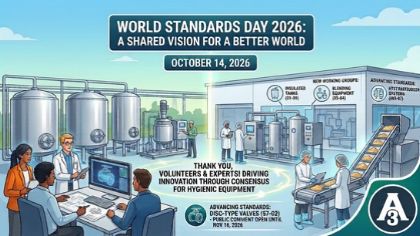
At 3-A SSI, this year's World Standards Day arrives at an especially appropriate moment. Across the organization's standards-development program, technical experts representing equipment fabricators, processors and users, regulators and other stakeholders are actively participating in the development and maintenance of hygienic equipment standards.

Observers are sought for 10 active 3-A SSI Working Groups

A proposed revision brings 57-02 in line with the updated General Requirements. You have until Nov. 16 to weigh in.

A team of poultry science students from Auburn University earned second-place honors in the 2026 Student Hygienic Design Competition with a novel solution based in physics.


