


Search

Search
Certifications
News & Events
3-A Knowledge Center

This summer, Richard (Rick) Bond retired from Anderson Instrument Co. in Fultonville, New York, and stepped into a new role as a 3-A SSI Certified Conformance Evaluator. Bond spent nearly 50 years building hygienic equipment before he ever evaluated someone else's. Through his new company, R+D Unlimited LLC, he's now bringing that half-century of hands-on experience to Third Party Verification inspections for equipment manufacturers across the industry.
Bond's career began in 1979, when he took a job as a machinist at Anderson Instrument. Over the next 47 years, he held nearly every position a hygienic equipment company has to offer: machine shop supervisor, mechanical engineering technician, product development engineer, staff engineer, and eventually engineering manager, overseeing teams across North America and India. By the time he retired in July 2026, he was leading the company's global product improvement group.
That path from the shop floor to the top of the org chart gave him an unusually comprehensive view of hygienic design.
“I basically started as a machinist,” Bond says. “I've seen every aspect of fabrication and manufacturing, welding, all of it. I've got a good understanding of what it takes to do them, and it kind of goes back to what they're trying to accomplish at the end: making a hygienic product.”
That range was matched by breadth of exposure. Over the years, Bond traveled to manufacturers, suppliers and customers around the world, including China, India and Europe, conducting supplier audits and troubleshooting process problems in the field. “It's not just about making the products,” he adds. “It's making sure that the consumer down the end is going to be safe, especially in today's world.”
Bond's interest in becoming a CCE didn't start this year. For 15 to 20 years, he worked alongside 3-A evaluators as Anderson Instrument's engineering representative during the company's own conformance reviews, an experience that planted the seed early. One evaluator in particular, who wintered in Florida and worked in the Northeast each summer, made a lasting impression.
“It always intrigued me, the hygienic design and trying to figure out how to make things work better and still maintain that level of hygienic concern,” Bond recalls. “I was interested right then. But it would have looked like a conflict of interest, being someone who did reviews while working for a company that had to meet them.”
So he waited. About a year ago, with more travel and personal time on his mind, Bond decided the timing was finally right: retire from Anderson Instrument, stay on part time as a consultant, and build a practice of his own as a CCE.
“I want to step back, but I really am passionate about it,” he says. “It just felt right for me.”
Bond holds five U.S. patents, and the first one still stands out. Anderson Instrument was exploring a radar sensor technology it had never used before, and Bond flew to Texas with an electrical engineer colleague to see how a supplier's product worked. The real challenge wasn't the sensor technology itself, but figuring out how to make it hygienic enough for a food or beverage processing line.
“The biggest challenge was, how do we make that hygienic transition from this product to the customer?” he explains. “How do we make this thing sanitary so that we can clean it and know it's safe?”
He worked out a solution on the flight home. “That sketch on a napkin on the airplane became a product design, which thus became a patent,” Bond recalls. “That was my baby.”
His most recent patent, issued in 2026, covers an AI cloud-based data recorder and event processor. But it's the earlier one, an electronic pasteurization control system, that Bond points to as one of his biggest achievements: three to four design iterations over roughly 15 years before it won FDA approval, replacing what had been an all-mechanical system. He believes it was the first of its kind to reach that level of approval for use in hygienic pasteurization processing.
Bond has served on the ASME Bioprocessing Equipment (BPE) Standards Committee for more than 20 years, including as a founding member of its Instrumentation subcommittee and, since 2008, as a contributor to its Process Instrumentation subcommittee, where he helped write the pressure and temperature sensor section of the standard and contributed to the development of other sections. He's currently working with the committee to add a new process instrumentation connection design to the standard.
“The standard is the basis of the concept,” Bond explains. “As you push the edge of what's possible, you go back to 3-A, you go to the other standards bodies, and you say, this is what we're trying to do, this is what we've done, and here's why we believe this is safe.”
That standards-writing experience shapes how he now thinks about conformance and inspection. Requirements need to be achievable and checkable, he says, so an evaluator can clearly determine what's good and what isn't. Just as important is prevention.
“Over my 47 years, I've learned a lot more from what went wrong than what went right,” Bond says. “It's about how we help people avoid making a mistake before it happens.”
Ask Bond why Third Party Verification matters, and he reaches for a couple of well-worn sayings. One is his own: you can't see the trees when you're standing in the forest. The other belongs to a former boss: the devil is in the details.
“A third party gives you another set of eyes,” Bond says. “Once you're in the forest, you don't always see all the trees. And it's always the little things that get missed.”
In his experience, a manufacturer going through TPV for the first time almost always finds something it wishes it had done differently, whether that's a missing material certification or a detail that simply wasn't considered. “Not necessarily bad, but they didn't think about it,” he notes.
For processors on the receiving end of that equipment, the benefit is confidence: knowing a supplier did its due diligence, backed by someone independent checking the work. And for regulators, the 3-A Symbol offers a shortcut. Inspectors who see the symbol on equipment tied to the Pasteurized Milk Ordinance can often check a box and move on, saving processors time and money. “Time is a big thing,” he adds. “Time is money.”
As he builds his CCE practice, Bond expects to focus where his background runs deepest: instrumentation, fittings, connections, valves and smaller components. He's candid that full plant-type 3-A approvals, which involve evaluating entire processing systems, aren't yet where he wants to work. “That's a big picture,” he says. “I wouldn't feel comfortable doing that right now.” Instrumentation, on the other hand, is “right up my alley.”
Asked what he'd say to a manufacturer who doesn't see the value of 3-A certification, Bond doesn't talk about paperwork. He talks about people.
“With the risk in the world about people getting sick or contamination getting into a product, that extra level of scrutiny, that second check, would help me sleep much better at night if I were an end user,” he says. “It's about the people, your kids or grandkids or nephews and nieces who are drinking milk and juice and eating food. It takes more than just one person to say yes, this is absolutely safe. You need those checks and balances.”
Bond is still early in building R+D Unlimited, but his goal is already clear: support equipment manufacturers across the United States, Canada, Mexico and Europe as they pursue and maintain 3-A certification. It's a new chapter, but one built on the same instinct that guided his 47 years at Anderson Instrument.
“My goal is to be able to do whatever I need to do to help support the customers and work through this,” he says, “and try to help them be better.”
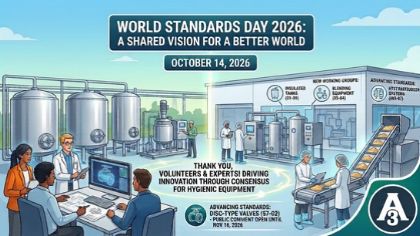
At 3-A SSI, this year's World Standards Day arrives at an especially appropriate moment. Across the organization's standards-development program, technical experts representing equipment fabricators, processors and users, regulators and other stakeholders are actively participating in the development and maintenance of hygienic equipment standards.
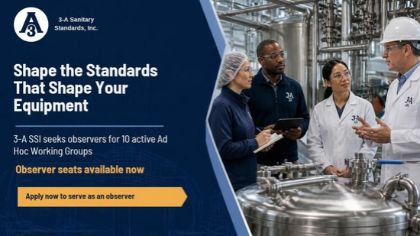
Observers are sought for 10 active 3-A SSI Working Groups
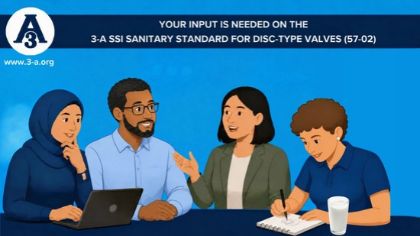
A proposed revision brings 57-02 in line with the updated General Requirements. You have until Nov. 16 to weigh in.
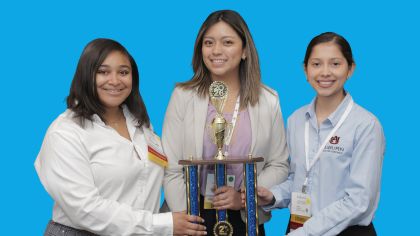
A team of poultry science students from Auburn University earned second-place honors in the 2026 Student Hygienic Design Competition with a novel solution based in physics.


