


Search

Search
Certifications
News & Events
3-A Knowledge Center
.jpg)
If you build disc-type valves, run them in a plant or inspect them for a living, this one's for you.
The Disc-Type Valves (57-02) Ad Hoc Working Group has finished its draft revision, and it's now open for public comment. From Oct. 1 to Nov. 16, 2026, anyone can review the proposal and tell the working group what they think.
3-A SSI recently revised its General Requirements (00-02), the baseline hygienic design criteria that every equipment standard builds on. Proposal B-57-02-A (N657) brings the disc-type valves standard into alignment with that update.
That matters because the General Requirements set the floor, and each equipment standard decides how to apply it. Under the 3-A SSI A- and B-level system, a revised 57-02 standard with specific rules for disc-type valves applies, including any exceptions to the general requirements.
The review centers on five permissions in the General Requirements and how a revised 57-02 will use them:
See something outside those five clauses? Say so. Comments on any part of the standard are welcome.
Standards work best when the people closest to the equipment help shape them. Fabricators know what can be built. Processors know what holds up through production and cleaning. Regulators know what passes inspection. A revision that hears from all three is one the whole industry can use. Comments from other stakeholders are also encouraged.
"A standard is only as strong as the industry input behind it," says Eric Schweitzer, 3-A SSI director of standards and certifications. "Food processors, equipment manufacturers and regulators each see disc-type valves from a different angle. When all three weigh in, the revision reflects how this equipment is actually built, cleaned and inspected."
Contact Eric Schweitzer at erics@3-a.org.
The working group did the drafting. Now it's your turn to make sure they got it right.
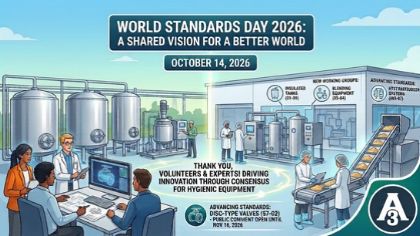
At 3-A SSI, this year's World Standards Day arrives at an especially appropriate moment. Across the organization's standards-development program, technical experts representing equipment fabricators, processors and users, regulators and other stakeholders are actively participating in the development and maintenance of hygienic equipment standards.

Observers are sought for 10 active 3-A SSI Working Groups

A team of poultry science students from Auburn University earned second-place honors in the 2026 Student Hygienic Design Competition with a novel solution based in physics.

3-A SSI invites volunteers for five new Ad Hoc Working Groups to revise four 3-A Sanitary Standards and one Accepted Practice.


