


Search

Search
Certifications
News & Events
3-A Knowledge Center

Food safety has a universal grammar. The principles are the same whether you are designing a stainless-steel valve, washing a tomato, or shelling a pecan. The settings change. The science does not.
That insight is central to how Karuna Kharel, PhD, assistant professor in the School of Nutrition and Food Sciences at Louisiana State University AgCenter, thinks about her work. It’s also why she was a natural fit for the inaugural class of 3-A SSI HyGEN Excellence Award winners. The award recognizes emerging food safety professionals under the age of 40 who are advancing the Gold Standard of hygienic design.
Kharel's research spans produce safety, low-moisture foods, and agricultural water systems, territory that might seem a step removed from the processing equipment world that 3-A SSI is best known for. She sees it differently.
"The main principle of hygienic design is to reduce the harborage sites, improve the cleanability, minimize the opportunities for pathogen persistence," she says. "If you look at it in a broader range, we are doing pretty much the same thing in fresh produce, agricultural water systems, low-moisture food, or any food system in general. Bacterial contamination often occurs when microbes find a protected niche where cleaning and sanitation are difficult, and then cross-contamination happens."
The industry, she adds, is moving in exactly the rightdirection. That is, away from reactive testing and toward prevention. "As the industry moves forward toward a more preventive approach, designing systems that prevent contamination becomes just as important as testing for contamination."
Kharel came to that conviction the way most researchers do: through a moment that made the abstract concrete.
Her master's research at LSU validated hot water treatment as a kill step for in-shell pecans, demonstrating reductions of E. coli O157:H7, Salmonella, Listeria monocytogenes, and Enterococcus faecium. She published the work, counted it as an achievement, and moved on. A couple of years later, her phone rang.
A pecan shelling company in Mexico was trying to export to the U.S. market and needed a validated kill step to meet FDA requirements. They had found her publication, were already designing a hot water system based on her parameters, and wanted her help walking them through the validation process.
"That was the moment when I realized that research becomes applied and not just limited to the lab," she recalls. "It was very exciting to see that industry partners were willing to implement those interventions in their facilities and trusted our science enough to even modify their operations based on our findings."
The experience changed how she pursues research. "Up until then, as researchers, we often measure success through our publications. But seeing a company change how it operates because of our findings was very meaningful. That's what I have been applying ever since, understanding where the problem is, trying to write that back as a grant proposal and deliver scientific solutions."
"...Seeing a company change how it operates because of our findings was very meaningful. That's what I have been applying ever since, understanding where the problem is, trying to write that back as a grant proposal and deliver scientific solutions."
That philosophy has translated into results. Within her first 18 months as an assistant professor at LSU AgCenter, Kharel secured more than $300,000 in grant funding as principal investigator, including awards from Louisiana Sea Grant to validate smoking and canning procedures for oysters and from the Louisiana Board of Regents to investigate the synergistic effects of UV-C light and chemical sanitizers for microbial safety in agricultural water.
The oyster project is a case study in how she builds a stakeholder-driven program. When she arrived at LSU, her appointment was research and teaching, with no formal extension component. So she self-invited.
"I started partnering with extension specialist colleagues in the department, and if they were going out for field days or demonstrations with stakeholders, I would tag along," she explains. On one of those visits, she observed home-scale fishermen processors smoking and canning oysters that were not fit for raw sale. Her food microbiologist's instincts kicked in immediately. She collaborated with a seafood extension specialist, wrote a Sea Grant proposal, and got it funded. "It has always been give and take. I go to those meetings, I learn about the needs, I come back to the lab, think it through from a science perspective to apply for the grant and deliver back scientific solutions."
"Neither food safety nor quality wins stand alone. The real winner is the science-based solution that delivers both."
The pecan work took another turn when growers pushed back. Hot water treatment, it turned out, caused kernel darkening, a problem that threatened consumer acceptance. "Nobody's going to buy a product justbecause it's safe," Kharel observes. "It also needs to be of good quality that consumers are going to like. Neither food safety nor quality wins stand alone. The real winner is the science-based solution that delivers both."
Her team's answer was steam. A custom steam conditioning chamber could achieve similar pathogen reductions in shorter exposure times, reaching into the cracks and crevices of the shell more efficiently while better preserving kernel appearance. The goal, as always, is the sweet spot: validated lethality without compromising quality.
Kharel's commitment to applying food safety knowledge beyond institutional borders extends to her work with the IAFP Nepalese affiliate,which she helped found. The idea grew out of a simple observation: over her nearly 10 years of attending IAFP meetings, the number of food safety professionals of Nepalese origin had grown from a handful to a visible community. Why not formalize it?
"Microbes don't recognize borders, so food safety solutions shouldn't either," she says. The affiliate now works to channel food safety knowledge from U.S.-based researchers back to Nepal, connecting American researchers with Nepalese government officials, industry professionals, and students. In July 2026, she was elected secretary of the IAFP Affiliate Council, a role that broadens her reach beyond the Nepalese affiliate to the organization's full global network.
For Kharel, the HyGEN Award is validation of a particular kind of ambition, the kind that measures success not by publications alone, but by whether a pecan grower in Mexico changed how they run their plant.
"This award validates the importance of applied research that bridges scientific discovery and industry impact," she says. "It also motivates me to continue developing practical solutions that improve food safety while supporting the needs of stakeholders."
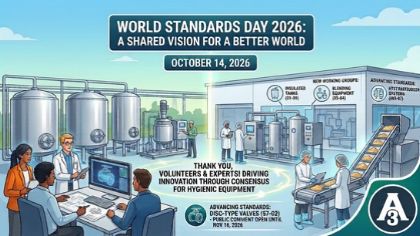
At 3-A SSI, this year's World Standards Day arrives at an especially appropriate moment. Across the organization's standards-development program, technical experts representing equipment fabricators, processors and users, regulators and other stakeholders are actively participating in the development and maintenance of hygienic equipment standards.

Observers are sought for 10 active 3-A SSI Working Groups
A proposed revision brings 57-02 in line with the updated General Requirements. You have until Nov. 16 to weigh in.
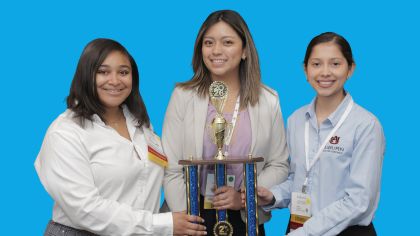
A team of poultry science students from Auburn University earned second-place honors in the 2026 Student Hygienic Design Competition with a novel solution based in physics.


