


Search

Search
Certifications
News & Events
3-A Knowledge Center

Food safety and hygienic design are built on a century of rigorous standards. But standards alone do not move an industry forward. People do.
That belief is at the heart of the HyGEN Excellence Award, a new recognition program from 3-A Sanitary Standards, Inc. (3-A SSI) that honors emerging food safety professionals under 40 who are advancing the Gold Standard of hygienic equipment design. In 2026, 3-A SSI named an inaugural class of eight winners selected from a competitive pool of global nominees spanning academic research, equipment engineering, and regulatory compliance.
"These winners are the new stewards of the Gold Standard," said 3-A SSI Chair John Kuhnz, "proving that rigorous hygienic design principles are the key to innovation, not a barrier to it."
Over the coming months, 3-A SSI will profile each member of the HyGEN Class of 2026. We begin with Benjamin O'Neil, Food Safety Regulatory Officer at Tetra Pak. He’s someone who has a very clear-eyed view of what this moment in the industry actually represents.
O’Neil says the most pressing risk in food safety today is not a gap in regulation or a failure of equipment design. He sees the greatest threat as the loss of knowledgeable and experienced people walking out the door, one retirement at a time.
"There's a generation of knowledge that's about to retire...These are people who have been in the industry since the 1970s...And when they're gone, it's going to be up to the next generation to navigate those waters without them."
"There's a generation of knowledge that's about to retire," he says. "These are people who have been in the industry since the 1970s and have all the experience with Low-Acid Canned Foods (LACF). They wrote the rules. And when they're gone, it's going to be up to the next generation to navigate those waters without them."
It is a candid observation from someone who takes that responsibility seriously. O'Neil's career already spans food science at Purdue University, thermal processing for NASA's space food program, and now aseptic filling validation for one of the world's largest food processing equipment manufacturers.
The NASA chapter alone would make for a good story. O'Neil spent four years at the Space Food Research Facility in College Station, Texas, managing thermal processing schedules, conducting heat penetration and temperature distribution studies, and traveling regularly to Johnson Space Center. But he is quick to point out what the experience gave him professionally: his first real grounding in process authority work, thermal validation, and the difference between food science as theory and food science as practice.
"At Purdue, it was very theoretical," he recalls. "At NASA, I was making the food. I was doing the heat penetration studies on the equipment to preserve it. That's where it all started to tie together."
From there, O'Neil joined Tetra Pak in 2019 as a Food Safety Regulatory Officer. His primary responsibilities center on validation and verification, or ensuring that aseptic filling machines perform as intended before they are released into commercial production in the United States and Canada. The equipment qualification process he supports is recognized by FDA as a means of demonstrating that liquid food processing lines meet the requirements for low-acid canned food regulations governing imports. He also works alongside Tetra Pak's design team to review new equipment against 3-A Sanitary Standards, flagging anything that falls short and working through redesign or modification as needed.
His path to that work took an unexpected detour through electron beam technology. While at the Space Food Research Facility, O'Neil found himself sharing a building with the National Center for Electron Beam Research. Its director, Dr. Suresh Pillai, knew O'Neil's background and offered him the chance to pursue his Master's degree in the lab. O'Neil took it, researching the use of electron beam irradiation to control yeast and mold on berries while working full time. It was, he acknowledges, a demanding stretch. It was also the credential that helped get him hired at Tetra Pak, which operates its own E3 electron beam platform for sterilizing packaging material.
"I'm not part of the design team on the E3 platform," he said, "but they present their work to me, and I provide feedback based on my experience. That's the kind of collaborative environment I've found [at Tetra Pak]."
O'Neil holds a range of certifications, including Preventive Controls Qualified Individual, Better Process Controls School, and hands-on electron beam training, but he is measured about what they represent. Most were opportunities that presented themselves and that he chose to take. The pattern is consistent throughout his career: curiosity, availability, and a willingness to say yes before he knew exactly where something would lead.
That same disposition shapes how he thinks about the HyGEN Award and what it should mean for the industry. He is glad to be recognized. He is more interested in what the recognition signals.
"I love that 3-A SSI is trying to get the younger generation involved, to tell them, you belong here."
"I love that 3-A SSI is trying to get the younger generation involved, to tell them, you belong here," he said. He went further, floating an idea that he hopes will take hold: a formal mentorship program that pairs emerging professionals with senior leaders before that generation retires. "Someone you can call up and say, I need some advice on this. I'd love to see it go in that direction."
It is, in a way, the answer to the risk he named at the outset. The knowledge does not have to disappear. It just has to be passed on, deliberately, and soon.
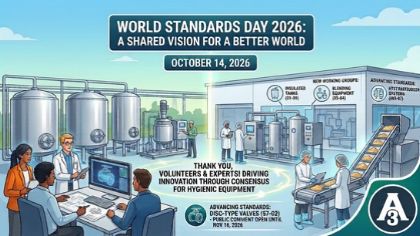
At 3-A SSI, this year's World Standards Day arrives at an especially appropriate moment. Across the organization's standards-development program, technical experts representing equipment fabricators, processors and users, regulators and other stakeholders are actively participating in the development and maintenance of hygienic equipment standards.
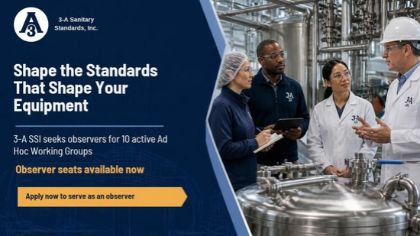
Observers are sought for 10 active 3-A SSI Working Groups
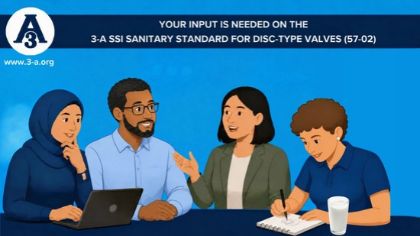
A proposed revision brings 57-02 in line with the updated General Requirements. You have until Nov. 16 to weigh in.
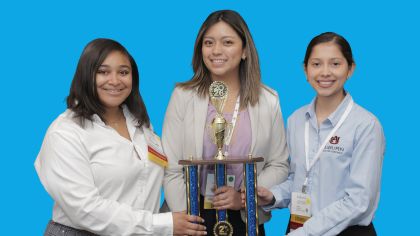
A team of poultry science students from Auburn University earned second-place honors in the 2026 Student Hygienic Design Competition with a novel solution based in physics.


