


Search

Search
Certifications
News & Events
3-A Knowledge Center

The 3-A SSI 2026 Summit on Hygienic Design was twice as nice for Kansas State University (KSU) graduate student Suhan Bheemaiah Balyatanda. Not only was she selected for the 2026 Dr. Ron Schmidt Student Travel Award, she also was honored as a member of the KSU first-place Student Hygienic Design Competition team.
Suhan, who is pursuing a PhD at the crucial intersection of low-moisture food safety and food engineering, presented a poster at the Summit proposing an innovative strategy to make flour safer. The companion research paper is presented below.
The Summit, Suhan says, offered a unique space to connect deeply with industry professionals, regulators, and academia alike.
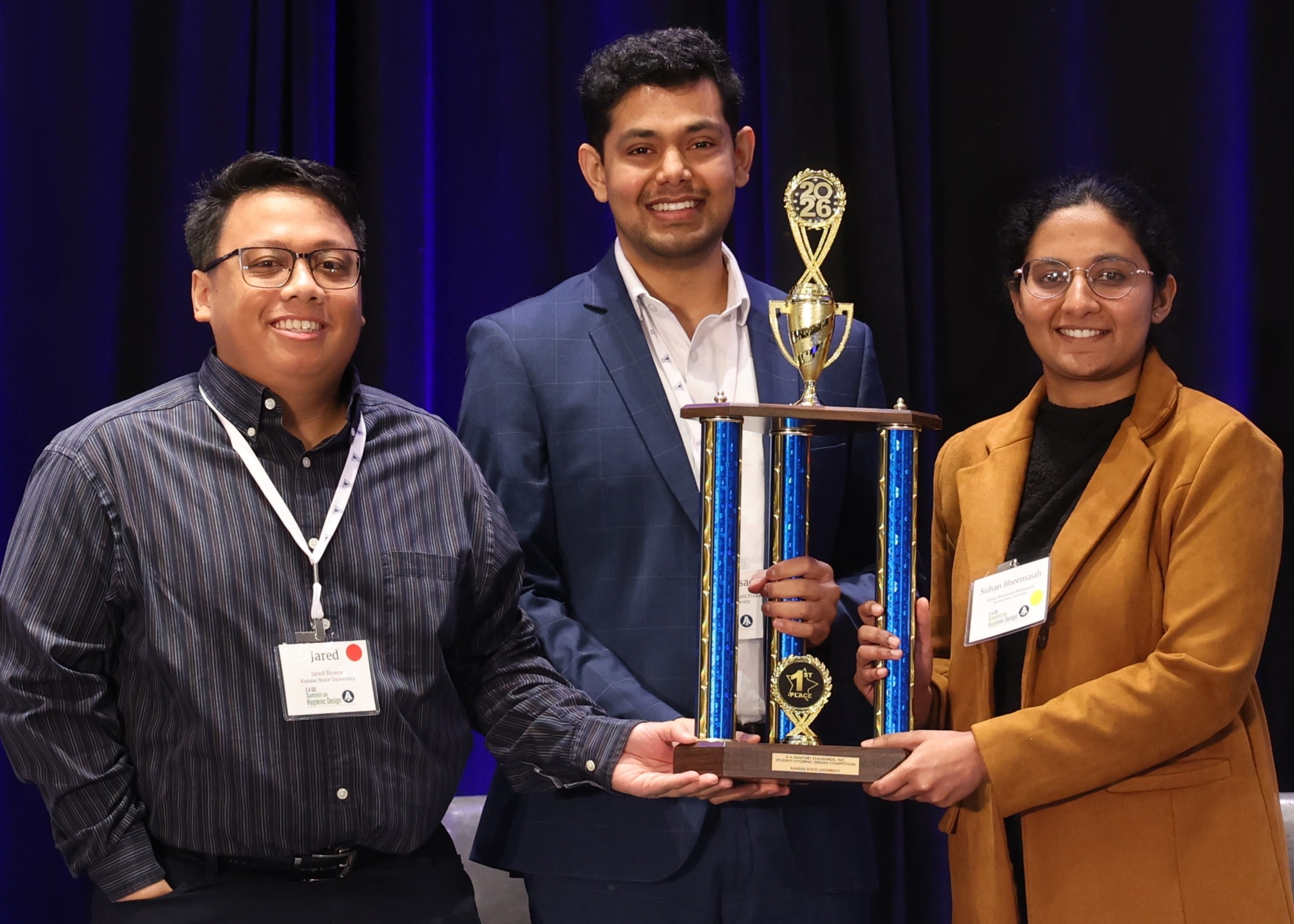
While Suhan says the technical sessions were rigorous and highly topical, it was the collaborative environment that truly stood out forher. Reflecting on the interactive nature of the event, Suhan says, "What I really did enjoy was some of the discussions that these topics led to. People would gather around a table, discuss, debate about some of these topics and also ideate on what could be done better." The format allowed Suhan to participate as both an observer and an active contributor, while also connecting one-on-one with professionals to learn how they navigate their careers.
This rare opportunity to learn from seasoned experts, Suhan explains, brought to mind Led Zeppelin’s “Kashmir” and the lyric to "sit with elders of the gentle race." The experience illuminated the future of the food industry and left a lasting impression on the role of incoming scientists, which "instilled a sense of responsibility that we are the future stakeholders of this industry," she says.
Suhan exemplifies the next generation of researchers that is already pushing hygienic design forward. Below, we are proud to present her research paper, “Milling the risk away: A chlorine dioxide intervention for safer flours.”
Suhan Bheemaiah Balyatanda
We all consume wheat in one form or the other: flour, cookies, cakes, dough. For a very long time we have assumed flour to be safe. When we handle milk or meat, we hesitate and at least ponder, if it was heated to the right temperature or was stored well. In contrast, when we handle flour we seldom subject it to the same scrutiny. As outbreaks associated with flour becomes recurrent and increasingly recognized; flour safety should be an important food safety conversation.
There are two ways to mitigate the risk involved with flour. One is to raise awareness and persuade people to not consume raw flour. Second, is to prevent the occurrence of such an event in the first place by curbing contamination upstream.
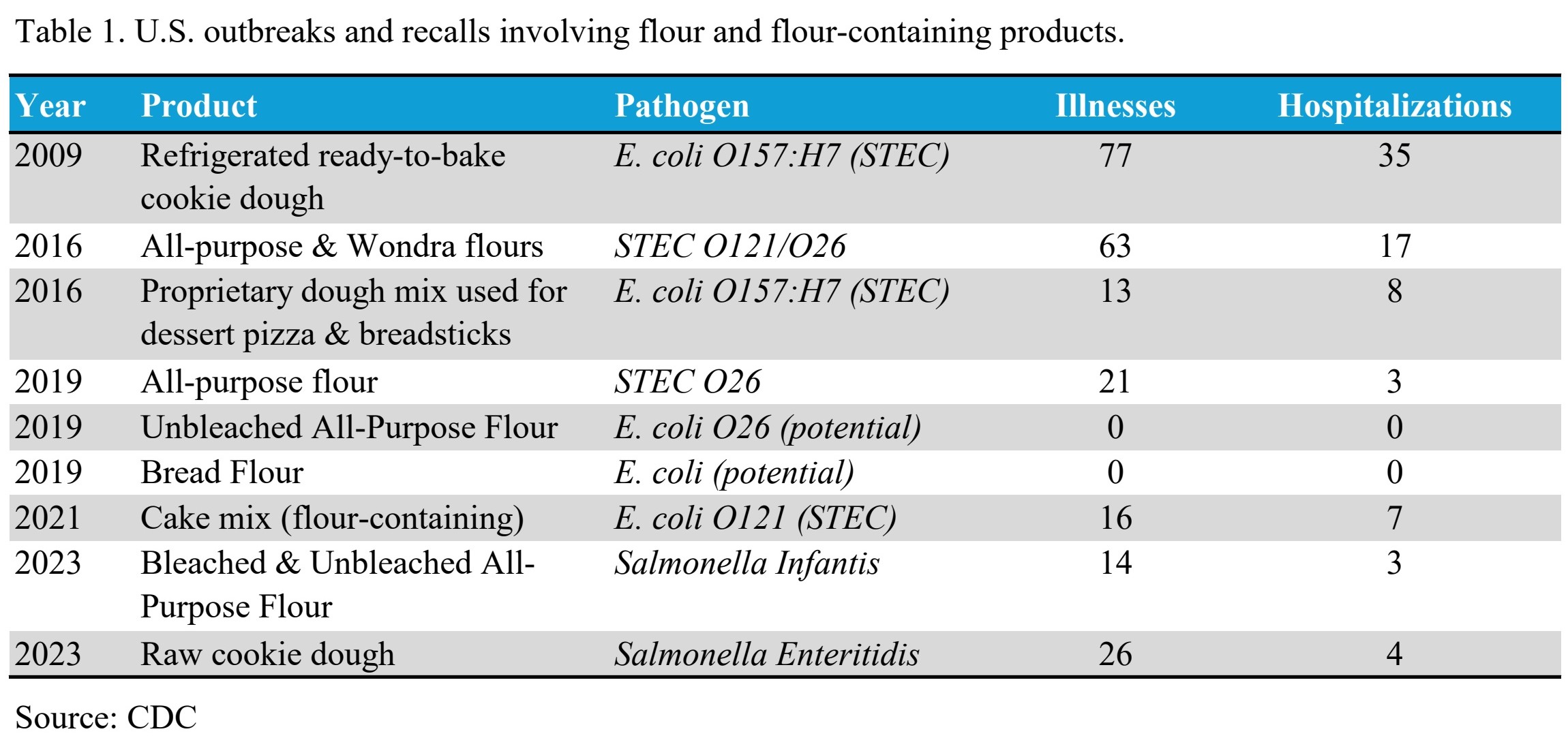
For the last couple of years we have been witness to several Class I recalls in flour and flour-based products (cookie dough, frozen pizza) due to biological contaminants such as Salmonella, E.coli and Shiga toxin producing E.coli (STEC) (Table 1). It is extremely surprising to see foodborne pathogens as the above in wheat flour, stranger even is while flour is not a great substrate for pathogens to flourish unlike meat or milk, their ability to survive and contaminate flour has raised concerns. The Centre for Disease Control and Prevention (CDC) estimates that while only a relatively small number of flour-related outbreaks are officially reported, the actual incidence is likely much higher with thousands of cases each year caused by pathogens such as Salmonella and E. coli linked to flour or flour-based products (CDC, 2025). Flour has been identified as the new vehicle for foodborne illnesses among other unusual food suspects. The prevailing hypothesis for such occurrences was cross contamination (brushing shoulders with the contaminants) or due to an adjuvant or ingredient other than the flour that served as a reservoir. However, the recurrence of recalls in flour has made it lucid that perhaps contamination of flour is not an isolated event. Contamination in flour is a real problem and a problem that will be around, unless addressed efficiently and sufficiently enough.
Historically flour has enjoyed a de facto ‘free pass’ in risk perception. It was not common to fret about flour safety or any low moisture food for that matter. Does that mean they were always safe? The current knowledge that even low moisture foods are prone to microbial contamination comes from improved surveillance and analytical methods or due to the emergence of resilient pathogens that have adapted to newer environments such as flour.
Since flour is shelf-stable, it lingers in pantries. Hence recalls must reach people for weeks or months and the economics involved in one such recall is often ruinous.
Since flour has no validated pasteurization (pathogen kill step) occurring at any point of time during or post processing one must be cautious while handling raw flour, especially around immunocompromised individuals, children and the geriatric populace. Tasting raw dough or batter, using no-bake recipes, making flour-based play-dough, and serving underbaked items can potentially bypass cooking safeguards. While flour may not help in proliferating the pathogens, they are known to sustain the cells. Even modest number of pathogens is flour can cause foodborne illnesses.
Flour underpins everyday staples such as bread, tortillas, pasta, cakes, cookies, batters, mixes with much of the supply coming from centralized mills that supply many brands. That means a tiny lapse at one point can spread through multiple products, states, and retailers before anyone notices. Since flour is shelf-stable, it lingers in pantries. Hence recalls must reach people for weeks or months and the economics involved in one such recall is often ruinous.
There are two ways to mitigate the risk involved with flour. One is to raise awareness and persuade people to not consume raw flour. Second, is to prevent the occurrence of such an event in the first place by curbing contamination upstream.
Research suggests about one-third of U.S. adults eat foods with uncooked flour and perceive little risk with the practice (Verrill et al., 2022). That means policy makers and manufacturers must proactively manage flour safety rather than leaving it to consumers alone. Preventive approaches offer millers practical controls and give regulators a clear basis for policy. Current preventive approaches have targeted supply chain, final flour controls, tempering and environmental sanitation.
In a typical flour mill, wheat grain sits in large storage structures called silos until it is needed for milling. Silos are the first point of contact between field grain and the mill and they are often fumigated with phosphine to prevent storage pests from damaging quality. Once the wheat enters the mill, it is sufficiently cleaned to remove stones, debris, chaff, and sub-standard kernels and then held in large tempering bins for 12-24 h. In tempering, water is added to raise kernel moisture from about 10-11% (storage moisture) to 15-17% (variety-dependent). This step eases break and reduction, improves separation of endosperm from bran and increases flour yield while by-product streams. Tempering is also the one notable moisture window in an otherwise dry-milling process. This has two implications; (i) high moisture if poorly controlled can allow microorganisms to persist or proliferate; and (ii) the same window can be leveraged for control by using validated antimicrobial approaches in the tempering water to reduce pathogen loads without compromising flour quality.
Using antimicrobial aids in tempering water has been a popular approach amongst researchers in flour safety. Use of sodium bisulfite, lactic acid, citric acid, propionic acid, plasma activated water, chlorine and ozone have been attempted. While they have been successful in reducing the pathogen load on kernels without quality compromises, they are often been combined with heat or other hurdles to achieve higher reductions. In practice, this implies new unit operations to be introduced that involves additional capital.
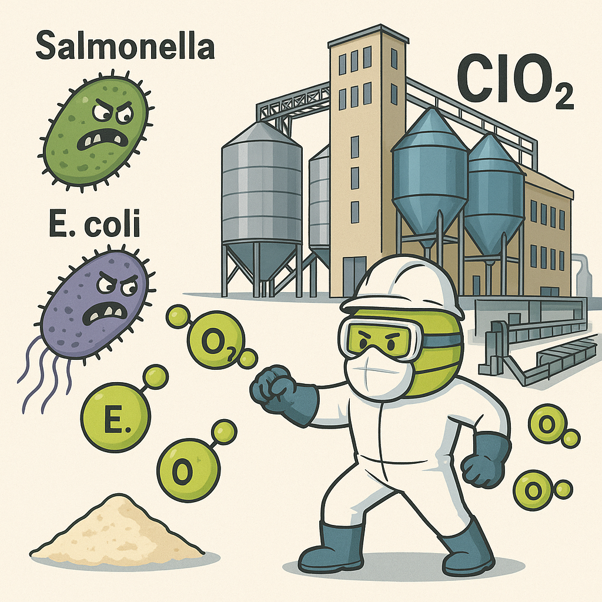
A promising alternative is the use of chlorine dioxide (ClO2) as a tempering aid. ClO2 is a powerful oxidizing agent with broad-spectrum antimicrobial properties effective against bacteria, yeasts, and molds, biofilms and even storage insects when used as a gas at low concentrations. The antimicrobial potency of ClO2 is also greater than that of other chlorine-based agents due to its ability to penetrate microbial cell walls and oxidize key cellular components without extensive chlorination reactions. ClO2 has been widely used as a sanitizer and antimicrobial agent in the food industry for many years. It is recognized as Generally Recognized as Safe (GRAS) and is regulated in terms of residual chlorite and chlorate levels in water and certain food products. Beyond its well-established disinfection efficiency, it is important to note that ClO2 is no alien to flour mills! The 1906 Pure Food and Drug Act, permitted the use of ClO2 as a bleaching agent in flour and was adopted afterwards by the British flour mills. In practice, ClO2 is applied post-milling that is it was used after the flour has been ground but before packaging or blending. The operation involves exposing freshly milled flour to a low concentration of ClO2. Over a period the gas bleaches the pigments (carotenoids) in the flour giving rise to a clean and uniform appearance to the flour and imparts desirable functional properties such as improved dough and consistent baking performance.
With an established precedent of use, ClO2 can be repositioned within the mill to reduce pathogens. Our research explored this idea by using ClO2 as a tempering aid at different concentrations from 300 to 1500 ppm to control Salmonella. Wheat kernels were sampled at different time points to assess the temporal reduction of pathogens on the wheat. At 1200 and 1500 ppm it was observed that ≥99.9% reduction in pathogens was achieved after 12 hours. Furthermore, milling yield showed no difference between ClO2 treated and water-treated samples assuring no offset in milling yield. Wheat tempered with ClO2 produced 1-3% more straight-grade flour yield compared to untreated wheat. The treated flour was slightly lighter (ΔL* increased by 2.5-3 units) and had the same particle size distribution and baking functionality. Importantly, ClO2 residues remained below detectable limits ensuring no chemical carryover to the final flour.
Collectively use of ClO2 in tempering water can significantly reduce microbial contamination on wheat kernels without adversely impacting flour quality, color or functionality.
What makes this breakthrough especially exciting is its compatibility with existing milling operations. ClO2 can simply replace or supplement the tempering water with no additional machinery or thermal steps. Due to the GRAS status its approval may not be a regulatory hurdle. While work progresses on scaling up the potent antimicrobials such as ClO2 to reinstate the pure joy of tasting the barter or dough, please be aware and educate the people around you to avoid eating raw flour!
CDC. (2025). Foodborne outbreaks: CDC. CDC. https://www.cdc.gov/foodborne-outbreaks/outbreaks/?CDC_AAref_Val=https://www.cdc.gov/foodborne-outbreaks/active-investigations/index.html
Verrill, L., Lando, A. M., Wu, F., Tatavarthy, A., & Obenhuber, D. (2022). Consumption of Raw Flour in the United States: Results from the 2019 U.S. Food and Drug Administration Food Safety and Nutrition Survey. Journal of Food Protection, 85(1), 31–35. https://doi.org/10.4315/JFP-21-256

At 3-A SSI, this year's World Standards Day arrives at an especially appropriate moment. Across the organization's standards-development program, technical experts representing equipment fabricators, processors and users, regulators and other stakeholders are actively participating in the development and maintenance of hygienic equipment standards.

Observers are sought for 10 active 3-A SSI Working Groups

A proposed revision brings 57-02 in line with the updated General Requirements. You have until Nov. 16 to weigh in.

A team of poultry science students from Auburn University earned second-place honors in the 2026 Student Hygienic Design Competition with a novel solution based in physics.


