


Search

Search
Certifications
News & Events
3-A Knowledge Center

The big reveal of 2026 Dr. Ron Schmidt Student Travel Award winners is coming soon. As the suspense builds, we present the eighth and final paper from the 2025 student travel award winners.
Interestingly, this paper addresses the same challenge—how to clean equipment in a low-moisture environment without getting it wet—as our 2026 Student Hygienic Design Competition (SHDC). It serves as a great reminder of the role that academic research can play in driving innovative enginering solutions, like those proposed by 2026 SHDC teams.
Join us at the 3-A SSI 2026 Summit on Hygienic Design to learn more about the winning SHDC team proposals and our 2026 Student Travel Award Winners.
The investigations from foodborne outbreaks have emphasized the need for an effective sanitation program to keep the environment free of pathogens. Current cleaning protocols in the food industry typically employ the use of water, cleaning chemicals and sanitizers. However, the use of water in low moisture foods environment might result in contamination and growth of pathogenic microorganisms like Salmonella. Thus, there is a critical need for cleaning method without the use of water in low moisture foods manufacturing facilities. In this study, air impingement technology has been explored as a potential alternative to the current wet cleaning methods.
The overall goal of this investigation was to evaluate the effectiveness of air impingement for removal of residues from surfaces in food manufacturing facilities. The specific objectives were to determine the influence of jet impingement velocity on the time to remove surface residues at different water activities and thicknesses, as well as residues at equilibrium for different durations of time.
The nonfat dry milk (NFDM) samples were equilibrated to different water activities using saturated salt solutions in the desiccators that were stored at ambient temperature. The length and width of NFDM deposits were 31.5 × 20 mm with three different thicknesses of 0.4, 0.8, and 1.2 mm. The NFDM samples on a stainless-steel coupon were placed on perforated porcelain desiccator plates and kept inside polypropylene desiccators containing about 500 mL of various saturated salt solutions. The relative humidity (RH) inside the desiccators was monitored by a hygrometer, and the accuracy of the RH sensor was ±3%. The ambient temperature varied between 15 and 25 °C depending on the season of the year, and this resulted in a small change in water activity of the salt solutions.
The experiments were conducted inside a ventilated balance enclosure to confine any dust generated by the impinging air jet at high velocities. The air impingement experiments were conducted using a 4-mm-diameter nozzle that was stationed at a distance of 32 mm from the geometric center of the stainless-steel coupons to maintain an H/Dratio of 8, where H is the nozzle-to-coupon distance and D isthe diameter of the nozzle.
The water activity of the NFDM deposits was the most significant among all the variables studied. The results indicate that NFDM residues with water activity of 0.33 were removed within 1 sat all WSS levels. The residues with water activity of 0.43 required a WSS of 5.66 Pa for removal in 13 s. The WSS of 8.32 and 9.48 Pa removed the residues with water activity of 0.43 in less than 1 s. As water activities of the NFDM residues were increased, the removal of the residues required longer time and higher WSS. For the water activities of 0.59 and 0.76, the time for removing the residues was 138 and 236 s at a WSS of 5.66 Pa, respectively. When the WSS was increased from 5.66 to 7.32 Pa, the time needed for removal decreased sharply from 138 to 28 s for the residues equilibrated at 0.59 aw. The time for removal of residues with water activity of 0.76 decreased linearly over the range of WSS from 5.66 to 9.48 Pa.
The time for removal decreased when the WSS was increased. The time for removal was about 5 s at 9.48 Pa. Similarly, for a WSS of less than 5.66 Pa, the time for removal exceeded 300 s,which was the threshold in the study. At a WSS of 9.48 Pa, the time for removal increased from about 5 s for residues at equilibrium to approximately 75 s for residues held at equilibrium for 7 days. In general, the influence of time at equilibrium on the time for removal of the residue was statistically significant (α = 0.05). A statistical comparison of the mean of times for removal (Tukey's HSD test) indicates that the effect of time at equilibrium is significant. Most likely, the increase in time for removal of the residue is the result of an increase in cohesive forces among particles within the residue, and the increase in these forces as the time after reaching equilibration increased.
The time increased with an increase in thickness of the deposit. The average time for removal of the residue with 0.40-mm thickness was 48 s. This removal time increased to 103 s when the thickness increased to 0.80 mm, and to 135 s for a thickness of 1.20mm. The WSS created by the exit nozzle pressure on the surface must overcome adhesive and cohesive forces within the deposit, and these forces increased with the additional mass associated with the increased thickness of the deposit. The effect of sample thickness on time for removal as an independent variable was statistically significant (p< 0.05).
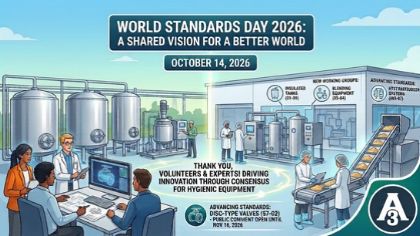
At 3-A SSI, this year's World Standards Day arrives at an especially appropriate moment. Across the organization's standards-development program, technical experts representing equipment fabricators, processors and users, regulators and other stakeholders are actively participating in the development and maintenance of hygienic equipment standards.

Observers are sought for 10 active 3-A SSI Working Groups
A proposed revision brings 57-02 in line with the updated General Requirements. You have until Nov. 16 to weigh in.

A team of poultry science students from Auburn University earned second-place honors in the 2026 Student Hygienic Design Competition with a novel solution based in physics.


